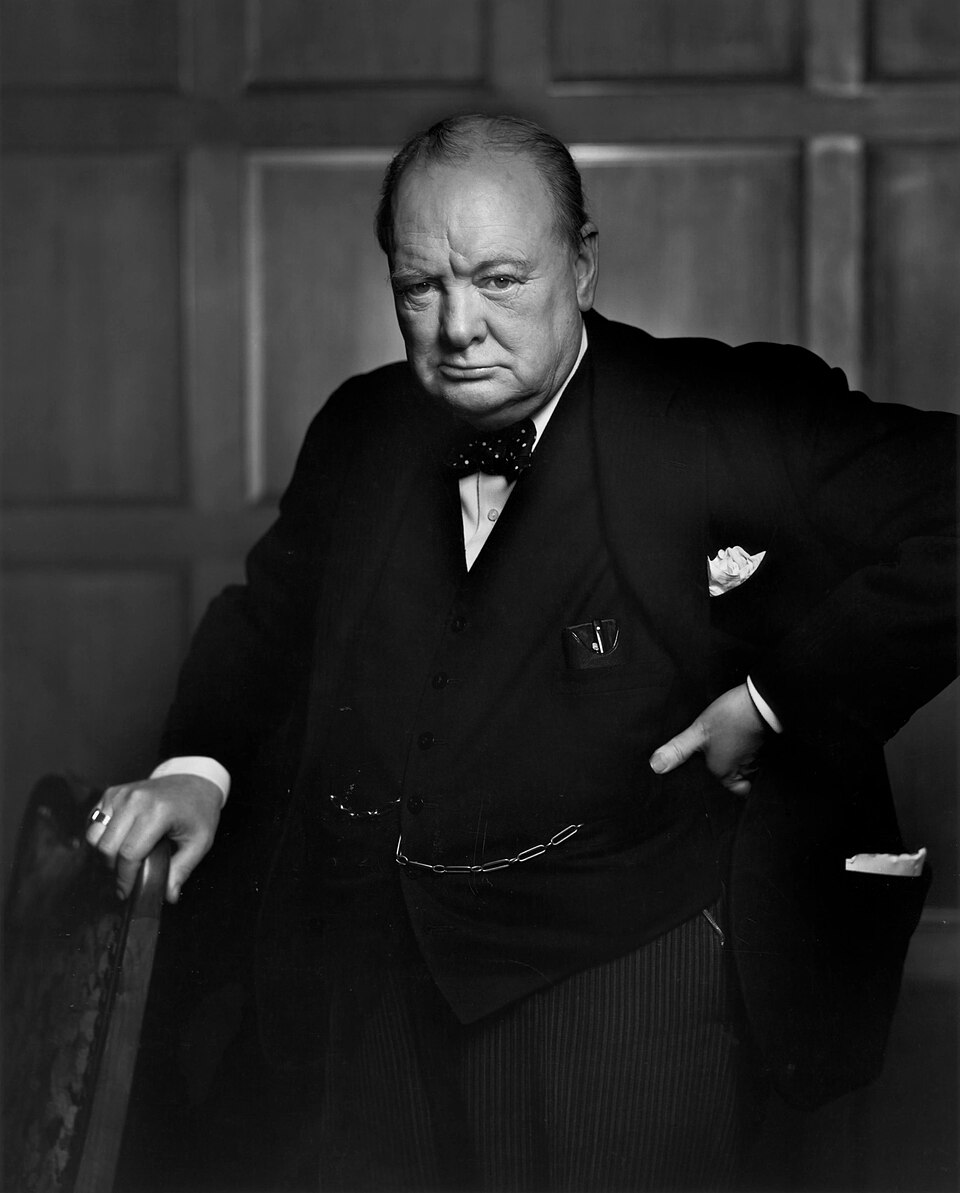
Sir Winston Leonard Spencer Churchill (1874–1965) was Britain's Prime Minister during the Second World War and is widely regarded as one of the greatest wartime leaders in history. Born at Blenheim Palace in Oxfordshire to an aristocratic family — his father was Lord Randolph Churchill, a prominent Conservative politician — Churchill had a distinguished early career as a cavalry officer, war correspondent, and author. He served as First Lord of the Admiralty during World War I and held several cabinet positions in the interwar years, though his reputation was damaged by the disastrous Gallipoli Campaign (1915).
Churchill became Prime Minister on 10 May 1940, the day Nazi Germany invaded France. With Britain standing alone against Hitler, Churchill's leadership and oratory became the stuff of legend. His speeches — "I have nothing to offer but blood, toil, tears and sweat"; "We shall fight on the beaches"; "Never in the field of human conflict was so much owed by so many to so few" — rallied the nation and inspired the free world. He forged the Grand Alliance with the United States and the Soviet Union, meeting with Roosevelt and Stalin at key wartime conferences in Tehran, Yalta, and Potsdam.
After Labour's landslide victory in 1945, Churchill served as Leader of the Opposition before returning as Prime Minister from 1951 to 1955. He was awarded the Nobel Prize in Literature in 1953 for his historical writings, most notably his six-volume memoir The Second World War. Churchill received a state funeral in 1965 — the last non-royal commoner to do so — attended by leaders from 112 nations. His legacy is complex — celebrated for his wartime leadership and defence of democracy, and criticised for his views on empire, race, and his role in events like the Bengal famine. Nonetheless, he was voted the "Greatest Briton" in a 2002 BBC poll and remains an enduring symbol of British resolve and defiance.