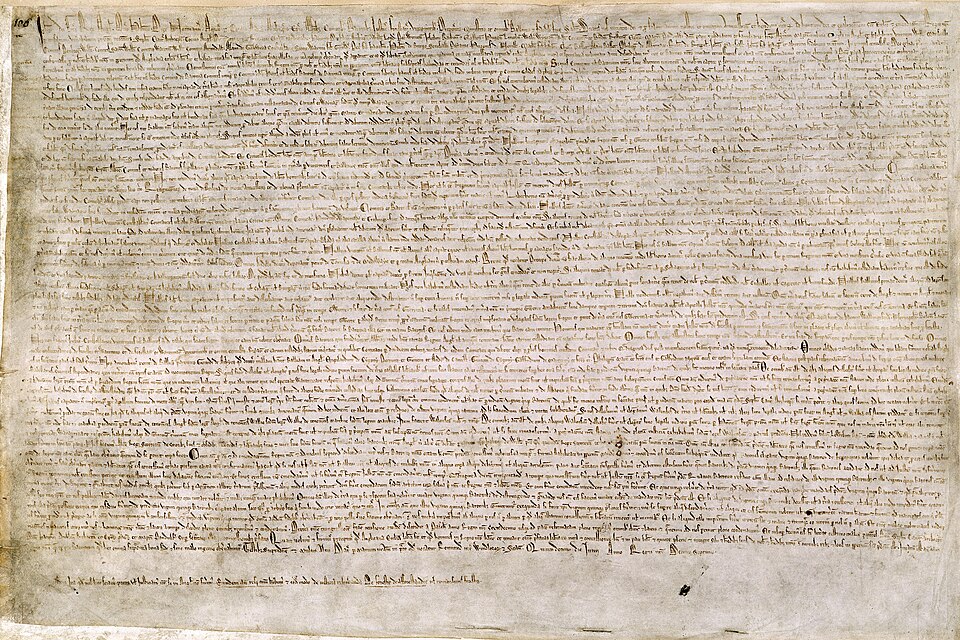
Magna Carta, Latin for "Great Charter," was sealed by King John at Runnymede on 15 June 1215. It was the first document in European history to establish that the monarch himself was not above the law. Drafted by a group of rebellious barons who were frustrated with the king's heavy taxation and arbitrary justice, the charter contained 63 clauses addressing grievances ranging from feudal payments to the regulation of weights and measures.
The most famous clauses — numbers 39 and 40 — declared that no free man could be imprisoned, outlawed, or exiled except by the lawful judgment of his peers or the law of the land, and that justice could not be sold, denied, or delayed. These principles laid the foundation for habeas corpus and due process of law. Though originally a practical political settlement, Magna Carta's symbolic power has endured for over 800 years.
Four original copies of the 1215 charter survive, held at the British Library, Lincoln Cathedral, and Salisbury Cathedral. Magna Carta was reissued several times in later centuries, and its principles influenced the English Civil War, the American Declaration of Independence, the United States Constitution, and the Universal Declaration of Human Rights. It remains a powerful symbol of liberty and the rule of law worldwide.